Introduction
Gold ingot casting is a core procedure for precious‑metal refineries, producing investment‑grade bullion for global bullion exchanges. For standard 1 kg gold ingots, two mainstream production routes dominate: manual pouring and automatic casting.
Traditional manual casting operates under open‑air conditions. Operators melt pre‑prepared gold feedstock in high‑frequency furnaces and manually pour molten gold into molds, followed by flame‑shielded cooling, washing and finishing. This old workflow relies heavily on operator skill, which frequently causes surface defects such as shrinkage marks, bubbles, slag inclusions and uneven surfaces. It suffers from low throughput, poor working conditions and unstable product quality, making it difficult to satisfy large‑scale modern refinery demands.
Automatic casting is split into one‑stop and tunnel‑type configurations. It adopts vacuum sealing plus inert‑gas shielding for melting and solidification, with PLC‑controlled medium‑frequency induction systems governing the whole melting‑casting cycle. Compared with manual operations, automated casting delivers higher output, consistent surface quality, reduced gold melting loss and improved workplace safety.
One‑stop automatic casting equipment for 1 kg gold bars has seen wide industrial adoption in South Africa, Germany and Italy for years. Domestic refining facilities in China have started deploying this technology recently. Real‑world production reveals several bottlenecks: low feed‑preparation efficiency, semi‑manual weighing, low yield for brand‑new graphite molds, and short graphite‑mold service life. These pain points restrict full utilization of automated casting capacity. This article introduces practical process improvements validated in commercial refinery production, along with measurable economic and operational outcomes.
Original One‑Stop Automatic Casting Workflow & Key Technical Parameters
The original standard one‑stop production sequence was:
99.99 % gold powder → melted gold blocks → granulation → oven drying → weighing & batching → automatic melting‑casting under nitrogen protection → demolding & cooling → quality inspection → trimming → marking & stamping → final packaging.
Gold granules (~1 mm particle size) were produced by a granulator at 1080 °C, then dried inside a 300 °C oven. The target weight for each ingot feedstock was controlled at 1000.10 ± 0.05 g. Core equipment includes granulator (40 kW output, max capacity 100 kg, max temperature 1300 °C) and casting machine (50 kW output, max capacity 4 kg, max temperature 1450 °C). Critical process parameters: initial vacuum −0.07 MPa, melting heating time (320 ± 30) s, cooling time (350 ± 20) s, nitrogen shielding pressure 0.1‑0.2 MPa, circulating cooling‑water pressure ≥ 0.2 MPa.
Before optimization, actual plant performance showed clear limitations:
- Feed preparation: Granulation for every 300 kg gold feed consumed ~6.5 hours, with extra time for melting gold powder into bulk blocks.
- Weighing: Manual batching for each ingot took 15‑20 seconds per piece.
- Quality: New graphite molds delivered merely ~50 % pass rate for the first 20 casting cycles; overall production yield stood at 82.65 %.
- Consumables: Graphite molds only lasted approximately 70 casting heats before replacement.
- Output: 8‑hour single‑shift maximum output reached roughly 300 kg of finished 1 kg gold ingots.
- Metal loss: Gold melting loss hit 0.015 % across the whole process.
Process Improvement Solutions
Engineers implemented four targeted technical revisions without major reconstruction of existing one‑stop casting hardware:
1. Simplify feed‑preparation workflow
The original multi‑step route “gold powder → gold block → gold granule” was shortened to “gold powder → gold block”. The granulation step was eliminated entirely. Production tests adjusted furnace heating duration incrementally. When melting time was tuned to (400 ± 5) s, direct casting from solid gold blocks achieved identical surface quality compared to granule‑fed production. This change removed one extra melting cycle, cutting 6 hours of processing time for every 300 kg feedstock and avoiding 0.005 % extra gold loss generated during granulation.
Revised optimized workflow:
99.99 % gold powder → cast 3 kg gold blocks → fixed‑length cutting → automatic wire‑gold fine weighing → automatic melting‑casting → demolding cooling → QC inspection → finishing → marking → packing.
2. Realize automatic weight batching
Gold blocks are cut via machine fixed‑length cutting to 53 mm length, delivering block weight of (490 ± 5) g. Two cut blocks supply ~990 g for rough weighting. An automatic gold‑wire cutting mechanism supplements the remaining weight to reach precise target mass. Final weight accuracy falls within 1000.03‑1000.10 g. Per‑ingot weighing cycle dropped from 15‑20 s down to 10 s, lifting automation level and throughput.
3. Boost product pass rate by graphite‑mold pre‑baking
Fresh graphite molds often produce defective bars in early heats due to internal moisture and material stress. Refinery technicians developed pre‑baking treatment: heat graphite molds inside resistance furnaces, holding constant temperature at 300‑350 °C for minimum 16 hours. This baking modification stabilizes mold thermal performance. After pretreatment, the product qualified rate stabilizes above 98 % and can approach 100 % in ideal operating conditions, effectively solving the low‑yield problem of brand‑new molds.
4. Extend graphite‑mold service life
Graphite suffers rapid oxidation under high‑temperature exposure to open air, shortening mold lifetime. Two combined countermeasures were adopted:
- Extend in‑machine cooling time for graphite molds to lower mold outlet temperature;
- Cover hot molds with heat‑insulated hoods immediately after ejection to reduce contact with ambient air and moisture.
These measures extended mold service life from ~70 heats to approximately 150 heats, a 2.0‑2.5‑times improvement, lowering consumable cost per ton of gold output.
Post‑Optimization Production Results & Economic Benefits
After deploying all process adjustments, plant operational data shows comprehensive enhancement:
表格
| Performance Indicator | Before Improvement | After Improvement |
|---|---|---|
| Single‑shift (8 h) max output | ~300 kg | ~500 kg |
| Gold ingot qualified rate | 82.65 % | 98.76 % |
| Gold melting loss | 0.015 % | 0.0025 % |
| Graphite mold service life | ~70 heats | ~150 heats |
| Weighing time per ingot | 15‑20 s | 10 s |
| Operators per shift | ≥ 7 persons | 4 persons |
Source: industrial production statistics from reference paper.
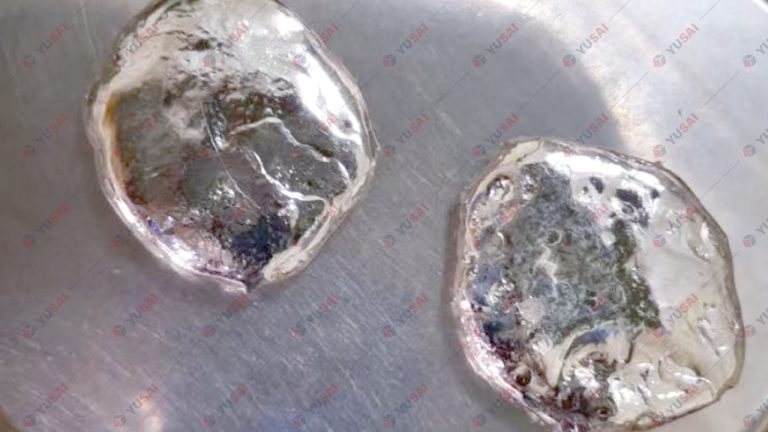
Finished gold ingots exhibit mirror‑bright, clean surfaces with drastically fewer shrinkage scars, pores and incomplete‑melting defects. From an economic perspective, each ton of qualified 1 kg gold ingots achieves total added benefit of roughly USD 6,200 (≈ 45 000 CNY), coming from reduced gold metal loss and decreased graphite‑mold consumption costs.
Beyond financial gains, fully‑enclosed one‑stop casting isolates operators from thermal radiation, open flame and harmful fumes. Manual workload is reduced, occupational safety is enhanced, and overall factory competitiveness for bullion supply is strengthened.
Conclusion
Optimized one‑stop automatic casting technology offers a practical upgrade path for refineries producing standard 1 kg investment‑grade gold ingots. Key takeaways:
- Removing granulation steps plus adopting automatic rough‑and‑fine weighing cuts feed‑preparation time and manual labor, while minimizing gold loss.
- Graphite‑mold pre‑baking and high‑temperature anti‑oxidation handling greatly raise product yield and extend expensive graphite‑mold working cycles.
- The whole‑set solution is retrofittable for existing one‑stop casting equipment without large‑scale hardware renovation, delivering high practical value for precious‑metal refineries across global markets.
For refinery planners and equipment buyers, these real‑world production benchmarks provide important reference when evaluating automatic gold‑ingot casting lines for LBMA‑compliant bullion production.